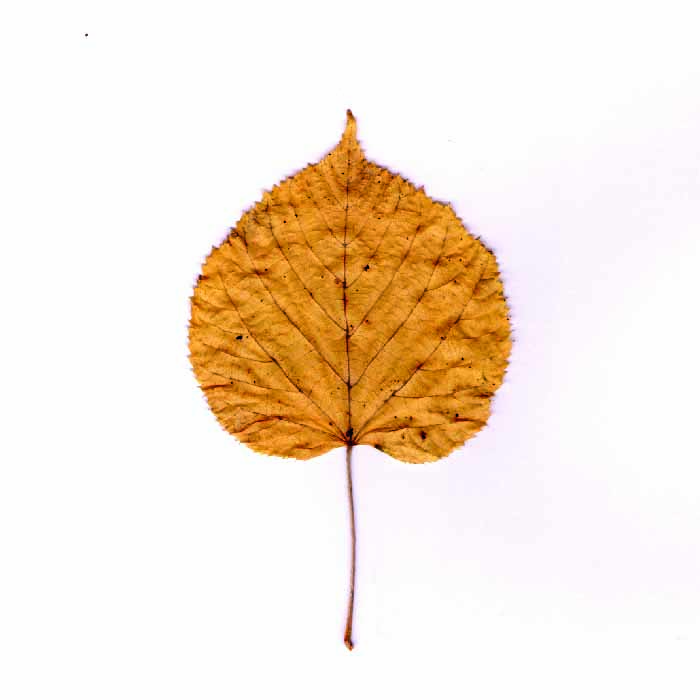
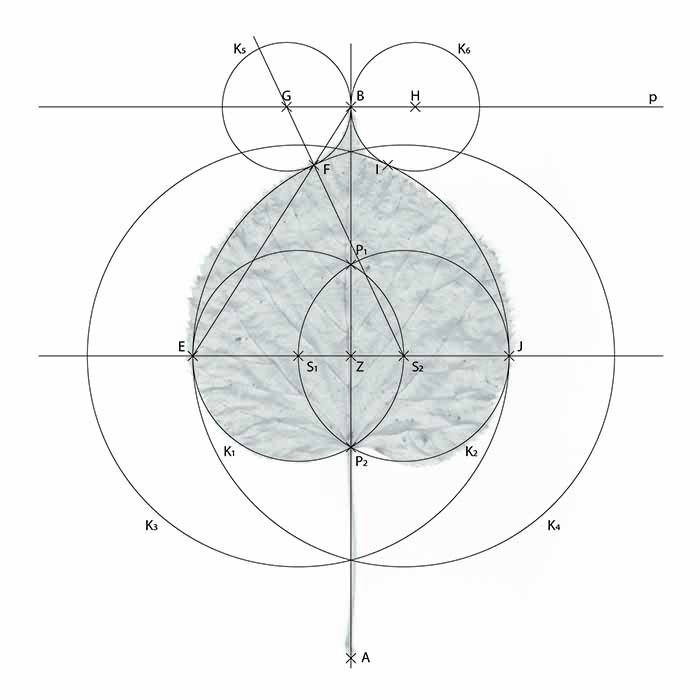
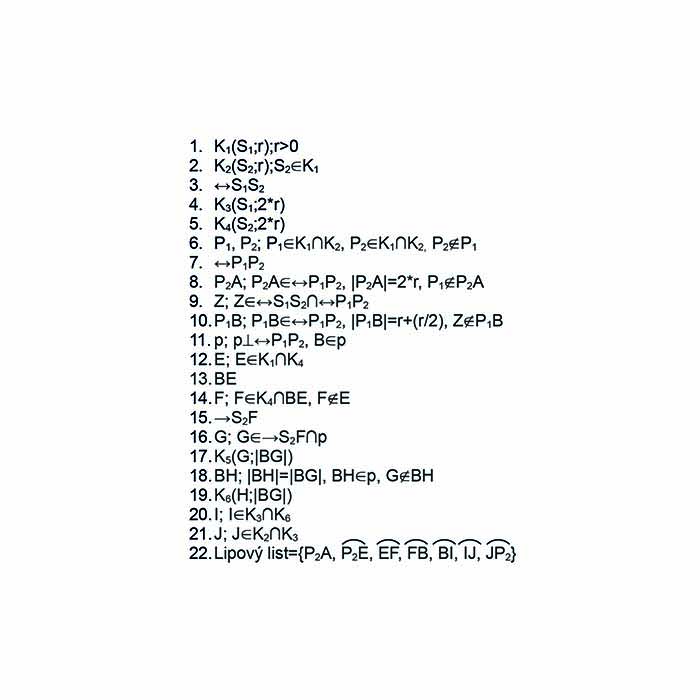
The first image is a simple photograph of a linden leaf. The second shows a geometric construction of the leaf’s shape. The shape is constructed using only six circles and a few other auxiliary geometric figures. It is remarkable that this leaf can be drawn very easily using only a pencil, a set square, and a compass. The size ratios of the geometric shapes needed for the construction are, in fact, very simple. For example, circles K3 and K4 have twice the radius of circles K1 and K2. The “stem” of the leaf (technically known as the petiole) also has a length equal to the radius of circles K3 and K4. The ratio of the petiole’s length (line segment P2A) to the leaf blade’s length (line segment P2B) is certainly worth mentioning. This ratio is 1:1.6143, which is an approximation of the golden ratio accurate to two decimal places (φ ≈ 1.6180…). The third figure is isomorphic to the second figure (it preserves all the information from the second figure and is therefore simply a different representation of the same thing). It uses symbols to show how to draw this leaf. The linden leaf is then defined as the set consisting of a single line segment (the petiole) and several arcs (the leaf blade).